Malnutrition and the Writ of Continuing Mandamus: The Remedy Befitting the Right
Introduction
Abject poverty breeds a many faceted dilemma. It plunges deep into the backwaters of ignorance and inability, sinking its sinister claws into that impenetrable and self-reinforcing triumvirate of endemic hunger, illiteracy and ill-health. The future begins to die away as a wounded nation clings to the crevices of judicial recourse in a desperate attempt to enforce the indefeasible and irrefragable substantive rights of every human person. Poverty forms a vicious circle, weaving together the soon inextricably intertwined elemental fibres of gender based discrimination and underdevelopment. Hunger, the greatest and most devastating phenomenon of them all, is the concomitant consequence of poverty, but hunger amongst children is more particularly detrimental to the existence of any society, for it stunts the mental and physical development of the future, thus perpetuating the vicious circle of poverty. State sponsored affirmative measures seem to be the only means of breaking free from the manacles of the morbidity and mortality associated with endemic undernutrition.
In the months of April-May, 2004, certain newspapers reported that 234 children in 5 districts in the State of Maharashtra had died of starvation, while 600 were clinging precariously to their lives. Within a fortnight, the Bombay High Court took suo motu cognizance of the matter and issued detailed directions for respite carving out a remedy where perhaps none had existed. With these directions came the reassurance of John Galsworthy’s singular declaration : ‘the law is what it is, a majestic edifice sheltering us all, each stone of which rests on another’.
Acute starvation is a problem of catastrophic proportions in India. It has led some to steal out of ‘weekly markets’ and ‘passing trucks’. Others have gone to the extent of selling their children so as to be able to afford food. Some have even eaten inedibles. Hunger is a disturbing problem, but in some cases there exist no possible remedies. If the situation of the State is such that it cannot afford food, there can hardly be any option of judicial or other recourse. Many countries are desperately poor. But when endemic hunger and malnutrition thrive amidst a culture of plenty, with excess food stocks fulfilling the goals of food security, a remedy becomes especially pertinent. Hunger is not a consequence of under-production, but the result of inequity and maldistribution. The situation is such that ‘if all the sacks of grain lying in warehouses were lined up in a row, the line would stretch for a million kilometers or so-more than twice the distance from the earth to the moon’. Starvation deaths, in such a scenario, cannot by any stretch of imagination, be justified.
The truth is that we are rich in our rights. Ours is the nation which began its hallowed existence on the pedestal of equality, life and freedom; where civil and political rights stood ensconced in the substance of a supreme Constitution. But not one of these rights means a thing if the people do not possess the fundamental human ability to exercise them. Of what use is the freedom of speech if the people do not possess enough food to eat? Of what use is the right to reside and settle in any part of the country if the people do not possess enough energy to walk? This poignant conundrum was elucidated by the United Nations Food and Agricultural Association (FAO) thus:
‘Every night, almost 800 million people in the developing world go to sleep hungry. That is more than the combined population of Europe and North America — a “hungry continent” of women, men and children who may never reach their physical and mental potential because they do not have enough to eat.’
However, in order to combat the problem which faces us today, it becomes imperative to gain an overall understanding of the nature of the problem, the substance of the right and the efficacy of the remedy. The focus in this article will not be on the malnutrition of all, but, more specifically, on the malnutrition of the children of the country.
Promises to Keep: Defining Malnutrition in the Context of the International Standards of Nutrition
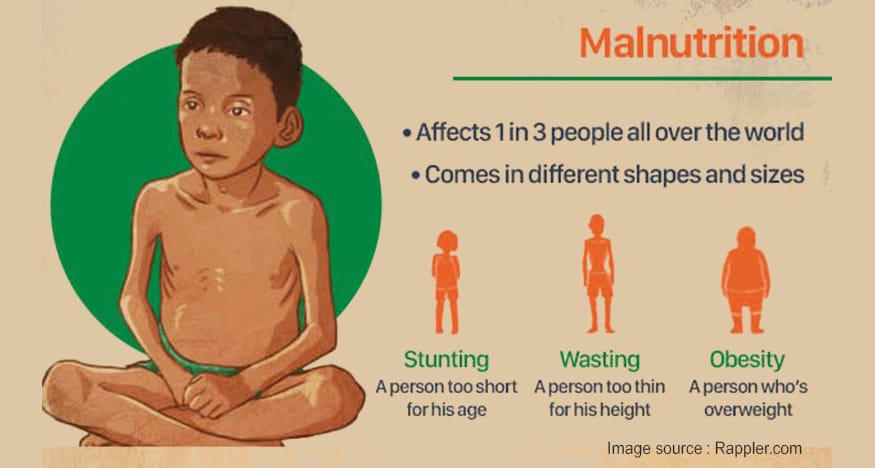
Malnutrition is commonly misconstrued. It does not refer to a situation where persons do not get enough to eat. It is thus mistaken for undernutrition, which is a situation where persons do not take in the right quantity of nutrients essential for normal body processes. Malnutrition, or in its most lethal form, ‘protein-energy malnutrition’, is ‘an imbalance between the supply of protein and energy and the body’s demand for them to ensure optimal growth and function’. It may result either from inadequate or excessive energy intake. Thus obesity may also be a consequence of malnutrition.
Undernutrition is that subset of malnutrition which results from the insufficient intake of essential macronutrients, i.e. protein, carbohydrates and fat; and of essential micronutrients, i.e. vitamins and minerals — iodine, vitamin A and iron in particulars. Its consequences are wasting, stunting and underweight. Wasting is a condition where muscle and fat tissue wanes away due to the insufficiency of food intake. ‘Stunting’ refers to the condition of a comparatively inadequate height while the condition of being ‘underweight’, as the term suggests, involves the incidence of a comparatively low weight.
Undernutrition, in turn, increases one’s susceptibility to disease and infection, particularly to those of kwashiorkor, nutritional marasmus etc. According to the World Health Organisation, undernutrition results in a sort of downward spiral. It has categorized the problem as follows:
‘Poor people may eat and absorb too little nutritious food, making them more disease-prone.
Inadequate or inappropriate food leads to stunted development and/or premature death.
Nutrient-deficient diets provoke health problems; malnutrition increases susceptibility to disease.
Disease decreases people’s ability to cultivate or purchase nutritious foods.
The downward spiral of poverty and illness can end in death.’
The first concern of any Government normally is: how does one determine if the people of the country are malnourished? While the determination of optimal nutrient intake may be an exercise in subjectivity and standards may vary, a certain minimum requirement can certainly be prescribed. In the context of children, ‘the three most commonly used anthropometric indices to assess their growth status are weight-for-height, height-for-age and weight-for-age’.
In order to survive, the body must generate energy. In order to generate energy, the body must consume pivotal sources of energy. These primary sources of energy are known as macronutrients. A full grown individual must consume 2400 calories in rural areas, and 2100 calories in urban areas per day. The requirement varies and becomes more specific when it comes to children. FAO guidelines (as documented by Latham) indicate the following energy requirements for children:
Age(months) Energy Requirement (kcal/kg)
0-3 120
3-6 115
6-9 110
9-12 105
Average 112
Micronutrients, though required in minuscule quantities, help, to a great extent, in the development of antibodies and others naturally created defence mechanisms. The optimum micronutrient consumption for children has been systematically laid down by Bienz, Cori and Hornig.
Malnutrition amongst pregnant women results in the low birth weight of the child. One of the determinants of malnutrition is the test of ‘low weight for age’. Under this comparative test, the child is considered to be undernourished if its weight is not proportionate to its age. This factor is influenced by the height of the child. Under the aegis of the FAO, Latham records the optimum weight for children as follows:
Age Group Weight (kg)
6-12 months 8.5
1-3 years 11.5
3-5 years 15.5
5-7 years 19
7-10 years 25
These international standards must be adhered to and kept in mind while developing a national nutritional policy.
Give us this Day our Daily Bread: Analysing the Prevalence of Socio-Economic Triggers
The problem of malnutrition is embedded deeper into the system than it appears to be. It stems from a large number of societal influences, which carefully insinuate the twin troubles of discrimination and hunger. It all begins with the failure of the law to remedy certain customary, yet backward practices, which have, for several years, encrusted the visage of our society. Early marriage seems to be the progenitor of malnutrition. While the law has, to some extent, been able to cut down on child marriage, it cannot play a one-sided role, without the support of awareness and social reform. A survey conducted by the National Family Health Survey (HFHS) reveals that 16.4% of urban women, and 34.4% of rural women, were married between the ages of 15-19. While education could have been a reducing factor, the primary reason for which women do not attend school appears to be a lack of interest, as also the high costs of education. Early marriage result in early pregnancies, with the net effect that 47.8% of the currently married women have 1-4 children between the ages of 15-19. Early pregnancies, in turn, have adverse consequences on the mother, whose ill health cannot be remedied due to the inadequate availability of medical facilities. The survey thus reveals that 56% of women between the ages 15-19 have anaemia in some form or the other.
What makes things worse is that food consumption does not depend solely upon the power of a family to purchase or receive food, but also upon the division of food within the family. There exists in our society, a discrimination in the basic distribution of food between different members of the family. The preference is always towards the male members, while the female members of the family are given lesser quantities of food. Not only is there a sex bias, but also an age bias which tilts against children. This places the girl child, in particular, at the bottom of the social rung. Applying the criteria of weight-for-age, height-for-age and weight-for-height, the survey reveals that 47% of children are underweight, while 18% are severely underweight. Similarly 74% have anaemia in some form or the other.
It cannot be said that the Government has not taken any action in ameliorating the position of the malnourished. Several schemes have been introduced which seek to create higher nutritional standards in society. The National Food for Work Program was introduced in 2004 with the objective of providing a means of livelihood along with foodgrains. The Antyodaya Anna Yojana was introduced in 2000 with the goal of providing foodgrains at highly subsidized rates. In addition, the Indian Council for Child Welfare runs several ‘Balwadis’ (day care centers), Creches and Early Childhood Education Centres all over the nation, while the Integrated Child Development Services (ICDS), established in 1975, seeks to provide supplementary nutrition, immunization, health check-ups etc. primarily through ‘Anganwadis’. The Mid-Day Meal Scheme (MMS) seeks to provide food in schools, thus serving both the educational and nutritional policies of the country, while the Annapurna Scheme (AS) and Balwadi Nutrition Program (BNP) seek to satisfy similar objectives.
What’s Law Got to Do With it?
It is certain that there are foodgrains in the country. It is certain that a considerable number of persons, children in particular, are malnourished, not due to the lack of food, but, even more so, due to the poor availability thereof. The Government has established programs to ensure that people receive what can be called their programmatic right, i.e. the right to food. However, when it comes to implementation, the Government has adopted not too enthusiastic an approach. The question that must then be asked is: can a person move the Court to seek the enforcement of his socio-economic right to food? In other words, can the Court enter into the domain of policy and budgetary allocation, in order to ensure that the right to food is guaranteed?
The Substance of the Right
The Constitution is not a mere document festering in the still waters of jurisprudence. It is a means to a larger socio-economic end. The fundamental guarantees and directive assurances enshrined in Part III and Part IV respectively are not ends in themselves. They are instruments which enable us to achieve a society characterized by liberty and freedom. All rights therein enumerated seek to give to every citizen of this nation, the opportunity to develop to her full potential. This is more particularly so when Constitutional directives animate and ennoble fundamental decision-making. The Constitution cannot, therefore, be subjected to narrow juristic limitations. It must be interpreted in a broader socio-economic context.
Constitutions, however, may differ. Some may find certain freedoms to be fundamental. Others may not attach as much importance to those freedoms jealously cherished by other societies. A prime example would be the right to property. But there are certain rights which are fundamental to the concept of existence. These are the rights to food, clothing and shelter, or what economics would call the necessaries to life. If the right to equality, freedom, religion etc. are conditions sufficient for the existence of civilization, these rights are necessary or intrinsic.
It is important to keep these observations in mind while we ask ourselves the question: Can Courts enforce socio-economic rights? In order to answer this question, it is first essential to dwell upon the fundamental difference between socio-economic rights and civil and political rights.
Civil and political rights, by their very nature, are negative rights. They embody an obligation of the state not to interfere in the enjoyment of certain freedoms. Article 14 ensures that ‘the State shall not deny to any person equality before the law or the equal protection of the laws within the territory of India’. Similarly, Article 21 finds that ‘no person shall be deprived of his life or personal liberty except according to procedure established by law’, the effect of which is negative. If the State interferes with a citizen’s right to speak, she can move the Court immediately and seek directions for removing the infringement of her right. But socio-economic rights are inherently ‘programmatic’ rights or positive rights. They are to be implemented over a period of time. Even the International Covenant on Economic, Social and Cultural Rights (1966) calls upon each State party to ensure the progressive realization of socio-economic rights through all appropriate means. This must be contrasted with the obligation imposed by the International Covenant on Civil and Political Rights (1966) which calls upon States to adopt ‘legislative or other measures .... to take the necessary steps’ for enforcing civil and political rights. Civil and political rights are thus negative rights, while socio-economic rights require affirmative State measures.
The very nature of socio-economic rights makes their enforcement difficult. However, liberal interpretation in momentous judicial pronouncement had the effect of protecting every person’s socio-economic rights. Thus, while Article 21 is couched in negative words, restricting its scope to a negative right, this right has evolved into both a negative and positive right through the process of judicial interpretation. The Munn v. Illinois guarantee of a meaningful and complete life permeated the negative boundaries of Article 21 in Kharak Singh’s Case and thereafter heralded the dawn of a new era of positive rights. The Supreme Court has taken up the Herculean task of ensuring that the Government fulfills its positive obligations, often entering into the fields of policy and governance, to enforce the individual’s positive right to life and liberty, through the process of public interest litigation in particular. Thus, the right to a clean environment was found to be a fundamental right. The right to education was likewise construed to be a fundamental right. The right to legal aid, to shelter, to a doctor’s assistance, to social justice etc. were all considered to be a part of Article 21. All the positive obligations cast upon the State by the Directive Principles of the Constitution, have been made a compulsory facet of governance by an activist judicial system.
Article 21 of the Constitution must also be interpreted in the light of Article 25 of the Universal Declaration of Human Rights (1948), Articles 11 and 12 of the International Covenant on Economic, Social and Cultural Rights (1966), and Article 27 of the Convention on the Rights of the Child (1989).
The Efficacy of the Remedy
The maxim Ubi Jus ibi Remedium proclaims that where there is a right, there is a remedy for ‘if a man has a right, he must ... have a means to vindicate and maintain it ... and, indeed, it is a vain thing to imagine a right without a remedy, for want of right and want of remedy are reciprocal’. Socio-economic rights might have been construed as fundamentally enforceable rights, but these rights are of no consequence if there exist no practicable and practical remedies for their enforcement. The Supreme Court has already recognized a fundamental right to food. The right to freedom from malnutrition has also been acknowledged. However, how does one enforce a fundamental right, which, by its very nature, is not a one-time right, but continues through the life of an individual? Can socio-economic rights, and in particular, can the right to freedom from malnutrition be enforced through a one-time declaration? Common sense tells us that for the practicalities of the directions to be worked out and implemented, constant vigilance and surveillance would be required. It is for this reason that the Court has devised an innovative remedy, the writ of continuing mandamus, whereby the inherently programmatic socio-economic right to food is implemented, not through the issuance of a one-time order, but through constant directions at repeated intervals.
The genesis of the remedy can be traced to the case of Vineet Narain v. Union of India, where there was a complaint against the inaction of the CBI regarding an alleged nexus between politicians and criminals. A writ in the nature of mandamus was issued, but the matter was kept pending so as to facilitate the review of progress and the issuance of orders from time to time. The Court found that:
‘The continuing inertia of the agencies to even commence a proper investigation could not be tolerated any longer. In view of the persistence of that situation, it became necessary as the proceedings progressed to make some orders which would activate the CBI and the other agencies to at least commence a fruitful investigation. Merely issuance of a mandamus directing the agencies to perform their task would be futile and, therefore, it was decided to issue directions from time to time and keep the matter pending requiring the agencies to report the progress of investigation so that monitoring by the Court could ensure continuance of the investigation.’
It was thus found expedient to issue orders from time to time in order to ensure a continuing compliance with Court directives. A similar remedy was evolved by the Supreme Court in environmental matters, where the implementation of Court directives was reviewed from time to time. The implementation of Court directives which sought to remedy the mismanagement of a hospital was similarly placed under Court scrutiny. Thus, in the enforcement of rights which are programmatic in nature, which require gradual but continuous changes, the writ of continuing mandamus would be a suitable remedy.
Courts and the Use of Continuing Mandamus
Perhaps one of the most momentous developments in the enforcement of the right to food was brought about by the Bombay High Court in an order dated 8th July, 2004, where a Division Bench found that State sponsored schemes, such as the Matrutva Anudan Yojna and the Nav Sanjivani Yojana were not being implemented with the effectiveness required of these schemes. Relying on an expert report, the Court recognized different grades in the levels of malnutrition, and thereby earmarked the urgency in each of the cases. In the light of the ineffective implementation of affirmative measures, the Bombay High Court issued the following directives:
A nodal committee was required to be established within a period of two weeks;
The nodal committee was to have the following functions
to formulate a policy for effective implementation;
to suggest budgetary allocations;
to ensure the proper monitoring of the activities at the district and village level;
Similar nodal agencies were required to be established at the district level;
Budgetary allocations were required to be increased in five districts;
The District Manager and the Chief Executive Officer were to be responsible for the implementation of schemes. Provision was made for penalties for erring officers;
NGOs connected with food scarcity and health issues were to be nominated;
The State Committee was to prepare a comprehensive nav sanjivani yojana applicable to all 15 tribal districts for the next 5 years and place it before the Court within the next 3 months;
The State Committee was to ensure that there would be no procedural delay in implementation;
All departments, including mobile health units, were to be provided with vehicles and adequate funds;
In addition, it was the duty of the State Committee to ensure that :
bleaching powder (for water disinfection) was made available to gram panchayats;
the food grain supply was adequate;
adequate supplementary nutrition was available to all beneficiaries;
health check-ups would be held periodically for children between the ages of 0-6;
the stock of vital, essential and emergency drugs was available;
posts of specialized cadres (gynaecologists etc.) was filled in;
each village had a trained dai;
health institutions were sanctioned as per the area norm;
the employment guarantee scheme was implemented;
100% appointments were made of Pada volunteers and mobile units;
the system developed by Dr. Bang would be implemented.
In addition, the State Government was called upon to consider the implementation of certain long term measures, and take steps to ensure that :
tribal areas were given 9% of budget allocation;
health institutions and ashrams were constructed in the next five years;
roads connecting all tribal towns to villages were constructed;
special attempts were made for increasing the literacy rate and the age of marriage;
the process of electrification of all villages was taken;
lands were allocated to adivasis as per State policy.
The State Government was directed to file an action taken report within a period of 6 weeks.
On reviewing the steps taken by the government in the implementation of the directives given above, a Division Bench of the Bombay High Court, on 21st October, 2004, issued the following directives:
The District Committees appointed above were required to independently grade children within the ages of 0-6 within a period of 6 months;
The State Government was called upon to implement a Government Resolution in this regard;
In tribal districts, 2300 anganwadis, which were still to be established, were required to be made functional within a period of 3 months;
The medical officer from primary health care was to periodically hold camps at these anganwadis;
In order to ensure attendance for the camps mentioned above, a program of publicity was to be put into action;
The government was to bear the expenses of travelling and allowance in exceptional cases;
Mobile units were to verify this data;
The home-based neo natal care scheme was to be implemented.
On 15th December, 2004, the same Division Bench of the Bombay High Court observed that out of 5,70,750 children in the five districts, only 2,27,115 children had been examined by medical officers. It was also observed that employment schemes in the region were required to be strengthened in order to curb the problem of malnutrition.
Similar observations were made in an order passed by the Supreme Court of India in People’s Union for Civil Liberties v. Union of India, where the following directives were issued :
Efforts were required to be made in order to ensure that SC/ST hamlets and habitations in the country had Anganwadi facilities as soon as possible;
Mobile units were to verify this data;
Contractors would not be used to supply food to the aforesaid areas. Instead, ICDS funds were preferably to be used;
All State Governments and Union Territories were required to put information regarding the State sponsored schemes on their websites;
The Pradhanmantri Gramodaya Yojana (PMGY) fund was also to be used for the purpose;
Children were to be provided with good food at the center itself;
The norm to be followed would be one rupee per child per day;
BPL would not be used as an eligibility criteria for ICDS;
All sanctioned projects were required to be operationalized and provided food as per the prescribed norms;
All State Governments and Union Territories were to fully utilize the amounts earmarked for the purpose;
Efforts were to be made to cover slums;
All the above directives were to be brought into effect in a timely manner.
It can thus be seen that the role of the Court has been one of systematic supervision, over a period of time. This continuing process has ensured that government bodies do not adopt a lackadaisical approach and that they remain accountable to Courts. In this manner, the Courts too can oversee the effective and timely implementation of measures in this regard.
Conclusion
When Courts begin to enforce socio-economic rights, they enter into a realm of administration, policy and budgetary allocation. The fine line between the executive and judiciary wanes away as Courts are accused of usurping powers and functions that are not theirs to begin with. For example, ameliorating the nutritional status of the country might perhaps involve a direction to the effect that the government should increase the amount of expenditure on nutrition in the country. Does such judicial activism contribute to the healthy functioning of a democracy?
The answer, it is submitted, must necessarily be in the affirmative. Courts have the all important role of being guardians and protectors of fundamental and essential freedoms. It is their duty to ensure that the rights enshrined in the Constitution are not reduced to meaningless aphorisms, but that they animate the functioning of our vibrant policy. When the executive knows that its decisions are subject not merely to public scrutiny, but even more so, to the searching scrutiny of a powerful Court, it realizes that freedom as fundamental as the right to food cannot be allowed to fall by the wayside.
In a nation plagued by populist executive action, judicial recourse seems to be the most efficacious (let alone the only possible) option for replenishing constitutionally fundamental and universally essential socio-economic rights. An activist, enlightened and inspired judiciary, perhaps the final bastion and repository of humanity and freedom, continues to labour strenuously to keep alive the children of this nation, and with them, the future of this great country.
Author Name: Abhinav Chandrachud